
Introduction
Behind every vaccination drive, nutrition programme and maternal health service in rural India, stand a workforce central to public welfare delivery, i.e., the Anganwadi and ASHA workers. They serve as the first point of support for pregnant women, malnourished children and poor or sick families. Yet, despite their crucial role, they still lack occupational recognition and remain classified as “honorary” employees. This classification excludes them from regular wages, labour protections, social security, and workplace safety guarantees. The widening gap between the essential nature of their work and the absence of formal legal recognition has increasingly come under judicial scrutiny and public protest, raising urgent constitutional, labour, and policy questions.
Who are the Anganwadi and ASHA workers?
Anganwadi Workers were introduced under Integrated Child Development Services (“ICDS”) to rely on local women who understood their communities and could deliver nutritional and maternal health services effectively. Their responsibilities include preschool education, nutrition and support to pregnant or lactating women, placing them at the centre of early childhood and women-centric welfare in rural areas, and selected urban pockets.
ASHA stands for Accredited Social Health Activists, who were introducedunder the National Rural Health Mission (“NRHM”), as local health mobilisers to promote immunisation, antenatal care, sanitation and basic health outreach.
Despite performing continuous and State-mandated functions, ASHAs remain classified under NHRM guidelines as “honorary volunteers” rather than workers. The programme originally envisaged ASHAs as part-time community activists working two to three hours a day, four days a week, without interfering with their primary livelihood. This premise has been repeatedly contradicted by practice, particularly during the pandemic. ASHAs are remunerated through task-based incentives under the National Health Mission, covering over 60 activities, funded through multiple budget heads. Incentive amounts vary sharply across States and activities, with payments often delayed for months or even years. While some States provide a modest fixed monthly honorarium, combined earnings frequently fall below minimum wage benchmarks, and income collapses during public health disruptions when routine services decline. Their volunteer status also excludes them from comprehensive social security frameworks, with insurance and pension schemes remaining ad hoc, time-bound, or inconsistently implemented.
Anganwadi workers face comparable vulnerabilities. Although their duties under the Integrated Child Development Services scheme are regular, statutory, and central to nutrition and child welfare delivery, they are paid honoraria rather than salaries and denied formal labour status.
Both work at the State-community interface delivering essential services in low-resource settings; many are women from the communities they serve. Government scheme rules set the role definitions and incentive structure. Together, these two cadres operationalise the State’s obligations under Articles 21, 39(f), and 47 of the Constitution, making their exclusion from labour protections legally significant.
ASHA workers’ protests during Covid:
ASHA workers’ protests are not new, they have been protesting since years now. India’s COVID-19 response relied heavily on ASHA workers, a cadre of over 10.47 lakh women deployed under the National Health Mission. During the pandemic, ASHAs were tasked with door-to-door surveillance, contact tracing, monitoring containment zones, distributing medicine kits, measuring oxygen saturation, facilitating institutional care, and mobilising vaccination. Multiple field studies, including by Azim Premji University andBehanBox, found ASHAs working 8-14 hours a day, often without personal protective equipment, travel allowances, or assured insurance coverage. Delays and non-payment of the promised Rs. 1,000 monthly COVID incentive were widely reported, alongside instances of public harassment and unsafe working conditions.
These pressures had triggered unprecedented collective action. In August 2020, approximately six lakh ASHAs participated in a nationwide strike demanding fixed wages, regularisation, and social security. In 2021, nearly 70,000 ASHAs in Maharashtra went on strike seeking higher pay and employee status. The scale of these conditions prompted the National Human Rights Commission to issue notices to the Union and State governments, seeking explanations on working conditions, delayed payments, and denial of benefits.
Why are the Anganwadi and ASHA workers protesting now?
The immediate trigger for recent protests lies in a growing disconnect between judicial recognition of Anganwadi and ASHA workers as de facto workers and the State’s continued refusal to translate that recognition into enforceable rights and protections.
Courts have increasingly rejected the State’s claim that these workers are merely “honorary volunteers” beyond the reach of labour law. In Maniben Maganbhai Bhariya v. District Development Officer, Dahod, 2022, the Supreme Court held that Anganwadi workers and helpers are entitled to gratuity under the Payment of Gratuity Act, holding that the continuity and statutory nature of their duties cannot be defeated by administrative labelling. Building on this functional approach, the Gujarat High Court in 2024 directed the State to take steps towards regularisation and parity with formal employees in respect of wages and benefits.
Despite these rulings, implementation remains uneven. Most Anganwadi and ASHA workers continue to be engaged under honorarium and incentive-based frameworks under the ICDS and National Health Mission, with pay, service conditions and social security largely left to State discretion. Although central guidelines have periodically revised honoraria since 2018, payments remain well below minimum wage benchmarks, vary across States, and are frequently delayed. In practice, travel and administrative costs often absorb a substantial portion of earnings. This gap between judicial acknowledgement and executive action has become a key source of dispute.
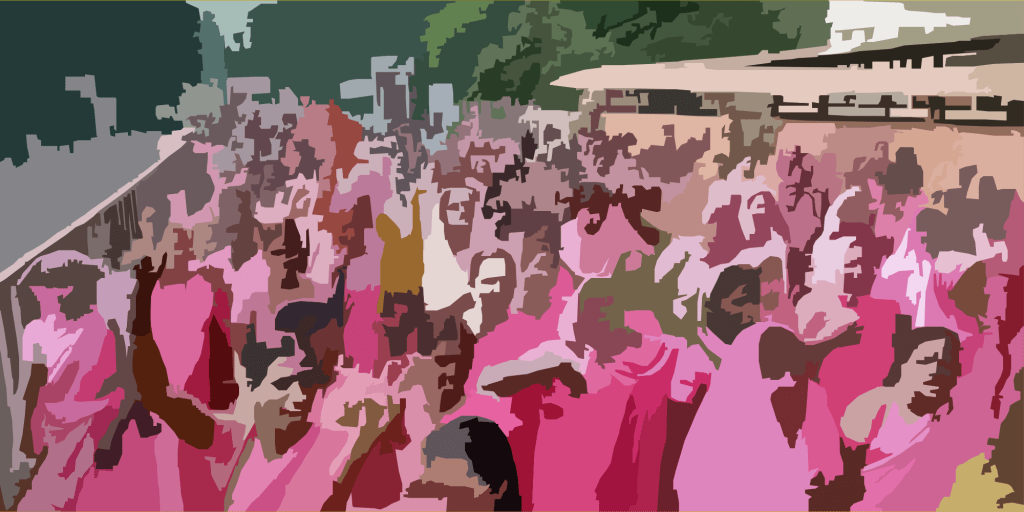
Against this backdrop, workers across States have mobilised for recognition as workers, fixed salaries, inclusion in social security schemes, hazard pay and safety protections. Protests such as the INAEF mobilisations in Kerala, the Belagavi strike, and demonstrations by ASHA workers in Srinagar, West Bengal, Meghalaya, Gujarat, Karnataka, and other parts of the country, reflect the discontentment. These mobilisations are often met with administrative pressure, restrictions on assembly and delayed payments. Each protest highlights the contradiction between the State’s reliance on these workers to discharge welfare obligations and its continued refusal to accord them formal labour protections.
What structural problems are these protests responding to?
The protests reflect deeper structural and legal vulnerabilities built into India’s welfare delivery framework, extending beyond immediate demands for pay or recognition.
The recruitment guidelines for ASHA workers propagate an inherent gendered approach to welfare delivery. Explicit instructions to hire women, especially married, divorced or widowed women, reflect the assumption that care work is an extension of women’s domestic responsibilities rather than specialised labour. Given that the work involves reproductive health education and contraceptive distribution, these positions were deliberately limited to women. Although this improved community acceptability, it also reinforced the gendered rationale that such work is a woman’s natural duty, contributing to the “feminisation” and the devaluation of care roles. Caste, class and regional inequalities further compounded these challenges.
Anganwadi and ASHA workers are designated as “honorary” under ICDS and NHM, leaving them with irregular honoraria instead of salaries. Many earn as little as ₹400 monthly , primarily spent on travel to mandatory meetings. Workers often describe themselves as “stuck between the government and villagers”, expected to deliver essential services without adequate support. ASHAs routinely promote sterilisation because it guarantees incentives, despite other appropriate options, which distorts honest service delivery. While governments claim that fixed salaries would undermine decentralised functioning and reduce accountability, this classification ultimately locks workers into a precarious labour structure with inconsistent earnings and no employment protection.
The safety and working conditions of ASHA and Anganwadi workers reflect the risks of their informal status. ASHAs often work without designated spaces and many Anganwadi centres remain shut or lack basic supplies such as menstrual pads and condoms. Workers accompanying pregnant women to hospitals report mistreatment and lack of overnight accommodation, with multiple reported incidents of workers being assaulted after unsuccessful births also highlighting their vulnerability to community violence.
The workers lack effective institutional safeguards against sexual harassment despite long hours, late night calls and solitary travel, leaving them with limited avenues for justice. The absence of Internal Committees or accessible reporting mechanisms violates the Vishaka Guidelines and the POSH Act, which mandate safe and protected workplaces for women irrespective of employment category. During COVID-19, workers undertook high-risk care work without PPE, adequate training or incentives. Many who contracted the virus were excluded from insurance or hazard compensation due to their informal status, which directly compromises the right to life, health and safe working conditions under Article 21. Workers further report inconsistent training; despite a formal framework, many receive little to no training while being expected to administer vaccines and provide antenatal support.
The Path Forward and Conclusion
If Anganwadi workers and ASHAa are recognised as employees, a suite of statutory protections and entitlements would become directly enforceable. The Minimum Wages Act, 1948, under section 3, empowers the appropriate government to fix minimum rates of wages for scheduled employments, so recognised ASHAs would be entitled to whatever state or central minimum wage applies to their skill or category. The Union Government had revised daily floors to ₹783/₹868/₹1,035 for unskilled/semi-skilled/highly skilled with effect from 1 Oct 2024, ~₹20,358–₹26,910/month on a 26-day basis. Employment status would also attract collective bargaining rights, social-security benefits and post-service benefits under the recently implemented Labour Codes.
However, if they remain classified as “honorary volunteers”, most of these statutory floors do not automatically apply and protections are largely discretionary or ad hoc. The NHM/ICDS incentive framework governs pay rather than the Minimum Wages Act, producing wide inter-state variance, for example, Andhra Pradesh and Karnataka pays ~₹10,000/month; while Uttar Pradesh pays ~₹1,500/month, with assured frequent delays. In that status, ASHAs must rely on policy circulars, temporary insurance or state schemes and public-law remedies to challenge non-payment or unsafe conditions.
Formalising worker status does not require the creation of central civil-service posts, it can be recognising Anganwadi and ASHA workers as employees under state-level schemes. This would allow their inclusion under minimum wage laws, regular salaries, and maternity benefits, reducing wage insecurity while still addressing the government’s concerns.
Notably, international models such as Brazil’s Family Health Program have successfully integrated community health workers into formal systems, resulting in improved health outcomes and worker protections. Similarly, Bangladesh’s community health volunteers operate with formal recognition, training and social security benefits, offering viable frameworks for India’s reforms.
The argument that fixed pay would lead to complacency or make it harder to monitor a grassroots workforce can be addressed through transparent digital reporting, performance evaluations and community-level accountability, all of which are possible without keeping workers informal and underpaid. Increased budget allocation to the healthcare sector would also allow better regulation of these workers. By integrating AWWs and ASHAs into the system, low incentives can be replaced with genuine accountability to the State.
Ensuring timely payments and removing intermediaries would prevent the current situation where workers have to chase their honoraria across offices. Regularising training and conducting updation modules would improve both quality and safety of care.
Although NHM guidelines provide block and district committees, they function only for supervision and not as Internal Committees. Adapting these structures into decentralised POSH-compliant mechanisms or establishing accessible local redressal systems would finally extend legally mandated protections to these frontline workers. Meaningful reform must bridge the gap between the essential nature of ASHA and Anganwadi work and the dangerous conditions under which it is performed. Strengthening wages, safety protections and ensuring rights of the workers is both practical and overdue.
Author
Rohini Arjun Nair
Batch 2025-2030
 GNLU CWCR - Rightfully Ours
Leave a comment