

INTRODUCTION
No woman can call herself free who does not own and control her body. No woman can call herself free until she can choose consciously whether she will or will not be a mother. — Margaret Sanger
Shockingly, an overwhelming 93% of disabled women are unjustly denied their reproductive rights, precipitated through forced sterilizations done in the name of “greater good.” The eugenics theory focuses on certain beliefs that are directed toward improving the quality of human genetics. One section of the population, Women in the informal economy, already facing unique challenges such as lack of legal protection, fair wages, and access to essential health services, are particularly vulnerable to these coercive reproductive policies. Among the numerous injustices they endure, forced sterilization remains one of the most egregious violations of their rights. This essay focuses on Forced Sterilization being a global issue that is closely tied to the discriminatory and immoral eugenics theory, which unjustly marginalizes individuals with disabilities under the informal economy and deems them genetically inferior to others.
HISTORICAL PERSPECTIVE
Social policy was developed in the nineteenth century, in part, in reaction to the Eugenics Movement, to treat society’s “defective” and impaired members. In 1849, Samuel Howe established the United States’ first facility for “defectives” and “feebleminded” people in Boston. Howe wanted to enlighten the “defectives” and ease their rehabilitation into society. Nevertheless, his efficacy in apprehending undesirable individuals from public spaces and the streets was such that communities and households no longer wanted their return. Near that time, Goddard also guided the idea of sterilization and segregation, especially targeting the female population. He wrote, “The feeble-minded have no forethought and no self-restraint. They are not adequately capable of resisting their own impulses or the solicitations of others, and they are unable to understand adequately the motives which guide the conduct of ordinary people.” Furthermore, nearly nine decades later, the world is yet to forgo the dark days of untermenschen sociology in Germany during the 1930s, which denoted the supremacy of the people with ‘pure Aryan blood.’ Coming to the 21st century, a recently published research article in September 2019, authored by 108 collaborating scientists, titled ‘The formation of human populations in South and Central Asia,’ is a crucial piece of text as it concerns itself with the genetic study of ancient humans. The Union Ministry of Culture recently, as of 28th May 2022, put out news in the New Indian Express regarding the Rs. 10 Cr (£1m) budget that will be dedicated to DNA profiling kits and equipment for “establishing the genetic history and trace the purity of races in India,” however, this news was quickly declared fake by the ministry. The propagation of this unscientific idea is not new to the Indian subcontinent; there have been multiple Adivasi communities that have undergone genetic testing.
THE INDIAN SCENARIO
Throughout history, forced sterilization has been used as a means of controlling marginalized populations. In India, sterilization campaigns were aggressively implemented during the Emergency Period (1975-77), targeting economically disadvantaged groups. This was a direct consequence of the Indira Gandhi administration, which launched a crash effort to cut the birth rate promptly as feasible, but it continued to grow at a rate of 2.2% per annum. In order to bring down the birth rate, the Indian government, operating under the Historical Intergenerational Trauma Transmission (HITTS) model, organized mass sterilization camps. Thus, sterilization became the mainstay of the population control program for the first time (called the ‘camp approach’).
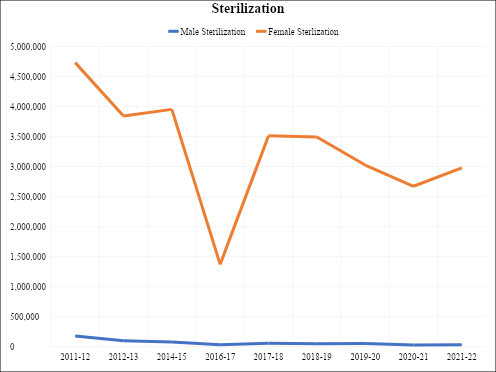
Women in the informal economy, many of whom were daily wage laborers, were subjected to sterilization procedures as part of state-driven family planning initiatives. The onus of sterilization was placed on such women, as reflected in the data from the 5th NFHS report, wherein about 37.9% of the surveyed women still deem sterilization to be their preferred form of contraceptive. In contrast, the number of males sterilized stands at a paltry 0.3%. Apart from the disproportionate onus of family planning, the sterilization of women is gripped by other disturbing problems, such as a lack of informed consent. As per data from the 4th NFHS report, only 46.4% of the participants were informed about the possible side effects and complications that could arise from such sterilizations. This data point is conspicuously absent from the NFHS-5 report. Additionally, certain procedures, such as laparoscopic tubectomy, may be performed without the patient’s full knowledge. As per the 2011 census, there were 8.2 million females with disability in India. Given that they form at least 1.9% of the population of India, this section of the population would also suffer the risks associated with sterilization. These risks would be further exacerbated by their socioeconomic and medical conditions. This gendered disparity disproportionately affects women in the informal workforce, who often lack access to healthcare services and information regarding their reproductive rights.
COMING TO THE LEGAL PERSPECTIVE
There are certain civic legislations in India, such as the Rights of Persons with Disabilities Act, 2016 (RWPD Act), which comprises measures to protect individuals with disabilities from all forms of exploitation, violence, and abuse in accordance with Section 16 (1). Additionally, Section 23 requests the State to uphold the rights of persons with disabilities and give them proper information so that they can bear children responsibly. This Section also protects the autonomy of a woman with a disability and gives her the liberty to determine whether or not she chooses to get pregnant. It acknowledges that reproductive and family planning education is important, and that people are given access to the resources needed to exercise their rights. Moreover, the provision listed under Section 4(1) of the RWPD Act asks the central and local governments to take necessary steps in order to guarantee that women and children with disabilities can enjoy their rights as any other set of people. Section 25 places the responsibility of providing sexual and reproductive healthcare, particularly for women who belong to the informal economy, on the shoulders of the government and the authorities under its jurisdiction.
Another legislation includes the Mental Healthcare Act, 2017, which deals with the protection of individuals against sterilizations that are taking place without their consent and free will. The sterilization of men and women is a forbidden procedure as per Section 95 of the Act. This rule applies when sterilization is intended to be used as a treatment for mental disorders.
POLICY RECOMMENDATIONS
In light of the various shortcomings of the present regime of family planning, we would like to put forth the following recommendations:
- Ad-hoc sterilization camps should be abolished. Delicate surgeries such as tubectomies and vasectomies should be performed in hygienic and dedicated institutions.
- En masse sterilization drives should be stopped to ensure that each patient receives quality healthcare, and the individual burden per surgeon is manageable.
- Sterilization targets should be abolished as they are inherently coercive and violate an individual’s right to bodily autonomy, integrity, and health.
- Sterilization targets should be abolished as they are inherently coercive and violate an individual’s right to bodily autonomy, integrity, and health.
- Sterilization consent forms must be printed in local languages to ensure that the patient comprehends the risks and tenders informed consent. Further, consent should not be obtained under coercion or sedation.
- The women should be made aware that they can withdraw from the operation at any time without losing their right to reproduction or other health services.
- Family planning in India requires a broader focus. The funding for sterilisation treatments needs to be reduced and redirected into a more extensive family planning awareness campaign.
CONCLUSION
Family planning is an important facet of social life. In the right hands, it can be a tool for economic prosperity and social well-being of the individual. However, in the hands of overzealous and despotic leaders, it can be a tool to target the poor and marginalised sections of society. Sterilisation, an innocuous process, has been used since time immemorial by those believing in deluded notions of a “pure society” to tailor the world as they see fit. Such beliefs are a serious threat to a woman with disability’s right to life and are a mere adaptation of the eugenics theory in the modern world. They, too, have a right to reproductive control, which is at par with other women. To deny them these rights is to deny them their existence as human beings.
 GNLU CWCR - Rightfully Ours
Leave a comment