
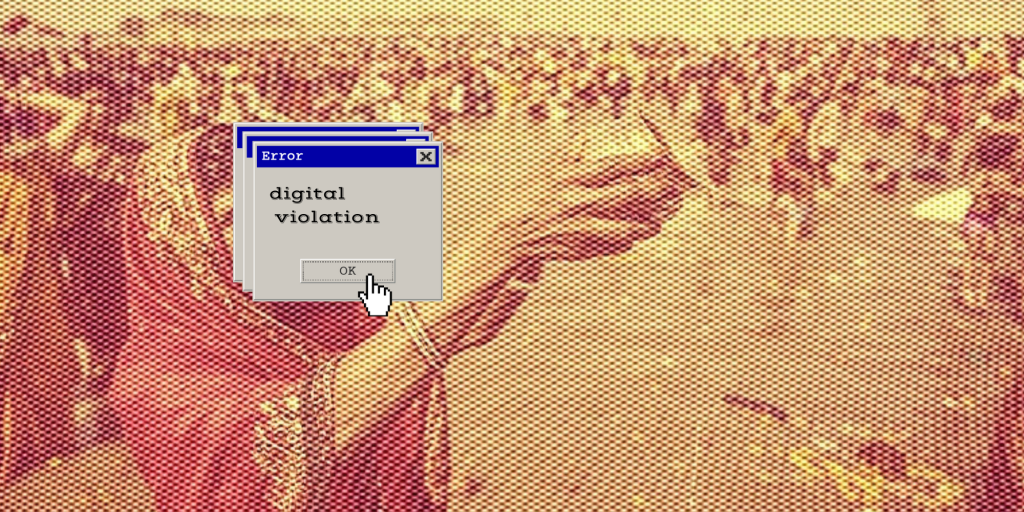
‘Not one incident of crime against women in Maha Kumbh’ boasted Yogi Adityanath, the Chief Minister of Uttar Pradesh, during his address to the State Assembly on 4th March, 2025. This bold statement claiming victory and painting a false picture of an unprecedented win in ensuring women’s safety at one of the largest religious gatherings in the world flashed all over the internet – perhaps the media and the government have a dangerously narrow definition of the word ‘crime.’ Because what else could explain the blatant ignorance surrounding the circulation of explicit videos of women and young girls, unknowingly filmed while bathing and changing, spreading across the corners of the internet?
This celebration of ‘zero crime’ once again raises a very unsettled and urgent question about online sexual harassment and digital violation of women’s privacy in our nation. Cyberviolence has always been the core of crime against women, or a better phrase would be a crime against society as a whole. Revenge porn, non-consensual image sharing, voyeurism, unauthorized filming, cyberstalking, sextortion, trolling, online dating scams, and abuses, the list is extensive. Women frequently face sexualized abuse online, with threats escalating to rape, ironically, from individuals who claim to uphold cultural values. A woman wearing makeup or showing skin is considered an attack on tradition, but issuing rape threats and hurling abuse somehow aligns with protecting the nation’s pride and culture. This glaring hypocrisy raises an urgent question: What legal protections exist for victims of such cybercrimes, and how effectively are they enforced, especially when national leaders publicly emphasize women’s safety as their topmost priority, yet their actions showcase blatant ignorance?
Introduced through the Criminal Law (Amendment) Act, 2013, Section 354C of IPC (Section 77 of the Bharatiya Nyaya Sanhita, 2023) criminalizes watching, capturing, or disseminating images of a woman engaging in a private act without her consent. The punishment for the same is 1 to 3 years of imprisonment for the first offense and 3 to 7 years for repeat offenders in both the old and the new criminal laws.
However, the major loophole in this provision is the definition of the phrase “private act,” which could easily be interpreted to argue that public spaces (e.g., bathing ghats at religious sites) do not qualify as “private”. The other provisions that deal with voyeurism are section 66E, which criminalizes capturing, publishing, or transmitting images of private parts without consent, and section 67, which prohibits publishing or transmitting obscene content online. Additionally, when it comes to the Information Technology Act, reports have repeatedly highlighted the lack of platform accountability, with no checks on why social media sites even allow such content to be shared in the first place.
Therefore, clearly, the current provisions are not of much help. First, the reporting rate of such cases is alarmingly low. Second, even if the complaint leads to the removal of such content, by that time it has often already gone viral, making its complete erasure nearly impossible. Ultimately, no matter how strict the laws become, the biggest challenge remains societal attitudes, particularly victim-blaming and the stigma attached to reporting such crimes. Legal provisions alone cannot ensure justice for victims without addressing these underlying issues.
Another major concern that this incident and the government’s attitude toward it highlight is the systematic ignorance or deliberate downplaying of such crimes when they are linked to religious spaces. In an attempt to preserve the sanctity of religion, people often choose silence over accountability, failing to recognize that the very occurrence of such crimes has already violated that sanctity.
Our nation has always been religiously sentimental, which leads to crimes involving women in religious spaces being either downplayed or outright denied, even by the government. When a crime against women occurs in any religious site or during any religious gathering, the first response is to deflect such news from coming to the mainstream. Authorities and media hesitate to acknowledge such cases, fearing they might tarnish the sanctity of these spaces, even if it comes at the cost of justice for the victim. This selective outrage is a strong depiction of our society’s priorities.
This is not the first time that such an incident has happened. Even in 2024, a similar incident was reported and very well ignored by the mainstream media when a hidden camera was found in the changing room at the Rameswaram temple. Despite the shocking nature of these crimes, they either don’t come into the public domain at all or quickly fade from public discourse.
Adding to the horror of such incidents is how society ignores and participates in the violation. There is a dark, hypocritical morality at play, where the same people who preach about “women’s modesty” and “cultural values” are often the ones who secretly consume and share such voyeuristic content. Instead of condemning the crime, many treat it as a source of entertainment, engaging in mockery, jokes, and humiliation of the victims.
The question then arises: who is responsible? The perpetrators, undoubtedly, but also the authorities who downplay these incidents, the media that refuse to highlight them, and the public that remains indifferent under the guise of protecting religious integrity. Why does a crime suddenly become a matter of “faith” when it occurs in religious spaces? Why is the victim’s dignity secondary to the image of these places? And most importantly, why does the legal system hesitate to intervene with the same urgency it does when “cultural values” are allegedly threatened?
A crime does not stop being a crime because it is not being talked about. Shielding criminals under the guise of faith is not devotion; it is complicity. Until we break this toxic cycle of denial, silence, and selective outrage, crimes against women in religious spaces will continue, and so will the hypocrisy of society. Justice cannot and must not be sacrificed at the altar of ‘avoiding controversy.’ The true sanctity of any place, religious or otherwise, lies in ensuring that it remains free from violence, not in covering up the crimes committed within it.”
 GNLU CWCR - Rightfully Ours
Leave a comment